
Let’s be honest: when you finally track down your great-great-grandmother’s maiden name after months and months of hunting, the last thing you want to do is stop and write a formal citation. You want to celebrate! You want to tell your friends and family! You want to keep climbing that family tree before the trail goes cold.
Yet in the world of genealogy, “citing sources” often sounds like a fancy way of saying “extra homework.” But here’s the secret: citing your sources isn’t about following stuffy academic rules. It’s actually your genealogy superpower. It’s the difference between a family history that stands the test of time and a collection of random names that might not even be yours.
So, let’s break down why giving credit to that dusty census record is actually a total game-changer—and how to do it without losing your mind.
1. Future You Will Thank Current You
Have you ever looked at a name in your tree from two years ago and thought, “Hold on. Why did I think Grandpa Joe was born in Ohio?” Without a source, you’re basically gaslighting your future self.
Genealogy is a giant puzzle. Sources are the “click” that tells you a piece actually fits. When you cite a source, you’re leaving future users (including yourself) breadcrumbs. If you find a conflicting record later, you can go back to the original reference material and see which source is more reliable. Citations are the “Save Game” button for your family history.
2. Don’t Bark Up the Wrong (Family) Tree
The internet is a wonderful place, but it’s also full of “zombie trees”: family trees where someone made a mistake in 2004, and now 500 other people have copied it. (I fell into this trap when I started my first Ancestry.com tree. Now I only add people to my new tree after I’ve personally checked a source.)
And the ultimate trap? Common names. Is your Mary Smith the one from London or the one from Liverpool? If you don’t cite a specific birth record or marriage certificate you found, you might accidentally merge two completely different people/families. Undoing the mess later could be a nightmare.
Citing sources keeps your tree accurate and “clean,” ensuring you’re actually researching your ancestors and not a total stranger’s.
3. It’s About the Story, Not Just the Stats
A name and a date are just data points. A source can tell a tale.
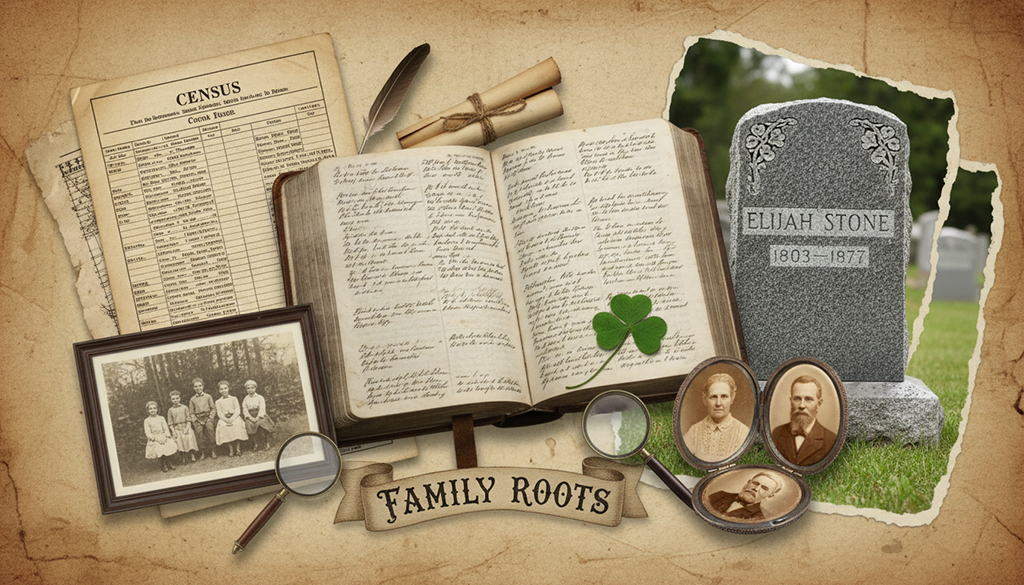
- A census record lets you know who the neighbors were and if the family originally spoke a different language.
- A military pension file might describe an ancestor’s physical appearance or a specific battle they survived.
- A will shows you who was the “favorite” child (or who got left the family cow).
By citing these sources, you aren’t just proving a date; you’re preserving the context of their lives.
How to Cite Without Being a Robot
You don’t need to memorize a 400-page style manual to be a good genealogist. For a personal tree, “casual citing” is perfectly fine. You just need to answer the “Who, What, Where, and When” so someone else could find it again.
| The Source | The “Quick & Dirty” Citation |
| Online Record (Ancestry.com, FamilySearch.org) | “1880 US Census via Ancestry, Page 4, Household of John Doe.” |
| Family Bible | “Handwritten notes in the Miller Family Bible, currently held by Aunt Sue.” |
| Grave Marker (Findagrave.com) | “Headstone photo, Oak Hill Cemetery, Austin, TX. Section B.” |
| Old Letter | “Letter from Grandma Rose to her sister, dated June 12, 1945.” |
The “Copy-Paste” Trap
We’ve all been there: you see a “hint” on a genealogy site and click “Add to Tree.” While those hints are amazing, they aren’t sources—they’re clues. Before you hit save, take ten seconds to look at the actual image of the document. Double-check the facts. If it looks right, jot down a quick note about what it is.
Think of it like showing your work in math class. You might get the right answer, but showing how you got there makes the result “reliable.”
The Bottom Line
Citing sources doesn’t have to be a pain or overly involved. It’s really just about being a good detective. It’s saying, “I found this cool piece of information, and here is exactly where I found it so the story doesn’t get lost.”
Your tree users and descendants (who will hopefully inherit your hard work one day) won’t care if your commas are in the right place. They’ll just be grateful they don’t have to redo all your research from scratch!
What’s the most surprising “proof” you’ve ever found for an ancestor—was it a formal document or something totally random like a back-of-a-photo scrawl?


Leave a Reply